- Markets
- Products
- Services
- News
- Tools & Resources
- About Nexans
- Search
- Contact us
- Compare
- Sign in




The low-carbon range of cables for power grid
Reduce your carbon footprint with Nexans low-carbon cables
of low-carbon aluminium
minimum of CO2 emissions (production phase)
of LV/MV cables manufactured in France
The first range of low-carbon distribution network cables on the French market
Based on a cable’s life cycle analysis, the Group has implemented a holistic approach to reduce the carbon footprint of its cables during the production phase:
- New range of low-carbon power cables for low-voltage (LV) and medium-voltage (MV) distribution networks.
- A 35% to 50% reduction (depending on product) in greenhouse gas emissions on the targeted product ranges.
- Designs incorporating low-carbon aluminum, recycled plastic, and stemming from a production out of renewable or decarbonized energy sources.
- Environmental data available, based on a set of indicators listed in PEP declarations verified by a third-party organization.
Nexans low carbon cables for grids:
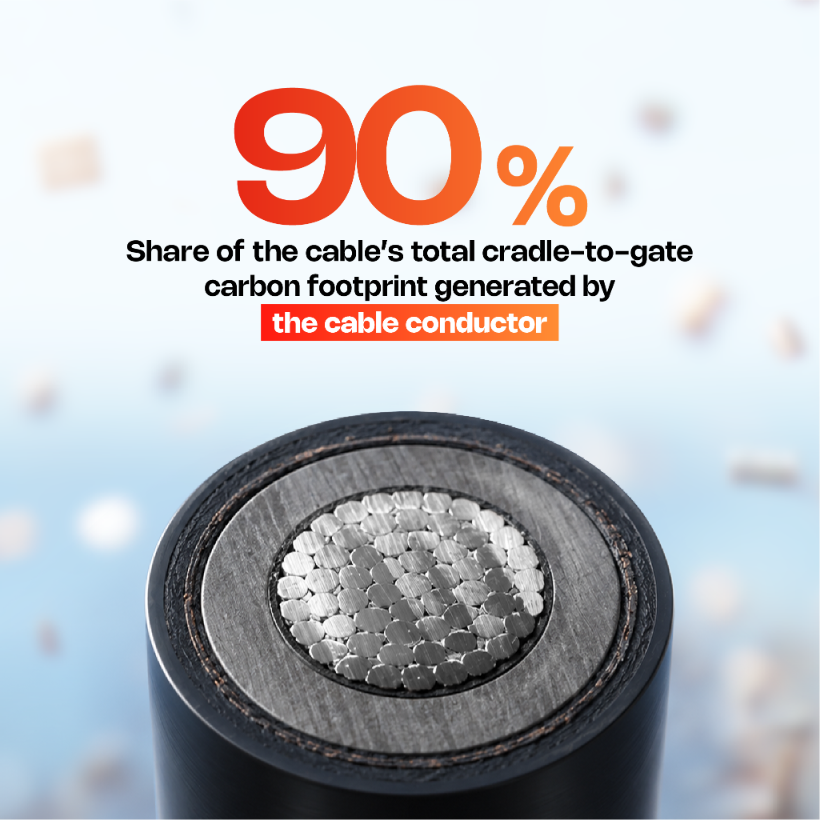
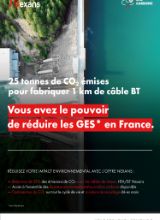
Manufacturing one kilometer of power cable generates a CO2 volume that is equivalent to two to three times the average annual per capita emissions in France[1]. These emissions come primarily from the aluminum conductor, which alone accounts for 70% to 90% of the total “cradle-to-gate” footprint, followed by plastics, transportation, and manufacturing process.
As part of its commitment to continuous improvement, Nexans set out a Low-Carbon Program aimed at accelerating innovation with regards the use of low carbon materials within cables by leveraging transparency in environmental data.
[1] Source: Ministry of Ecological Transition and Territorial Cohesion: France’s Carbon Footprint from 1995 to 2021 | Data and Statistical Studies (developpement-durable.gouv.fr)
Environmental data transparency driving low-carbon innovation
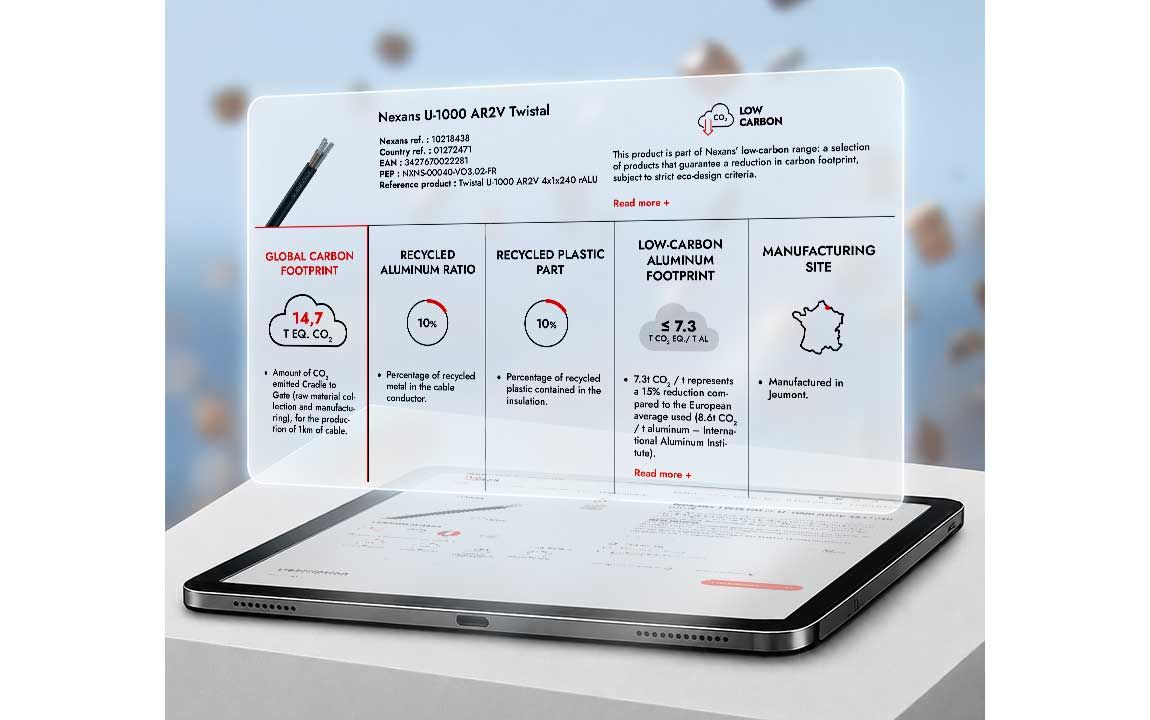
Nexans low-carbon cable range falls within the global Low-Carbon Program, rolled out across the Group, which provides easy and fully transparent access to product environmental data. The latter is displayed on product sheets available on Nexans websites for any product covered by a Life Cycle Assessment (LCA). A set of indicators listed in the corresponding PEP declarations can be found on products pages and datasheets allowing users to assess the cables’ environmental performance at a glance.
More about Nexans low carbon approache:
As a founding member of the PEP program, Nexans has been publishing environmental declarations for over 15 years. These standardized declarations are publicly available on the PEP program website.
To help distribution systems operators, installers and wholesalers/retailers manage their carbon emissions, Nexans also provides, upon request, a carbon footprint assessment on a per-project or per-customer basis, allowing to aggregate the environmental data from the corresponding technical proposals.
Continuous improvement of the environmental footprint of cables
To minimize the environmental footprint of its products, Nexans prioritises the levers that deliver the greatest impact at the cradle-to-gate stage of the product lifecycle
- The guaranteed use of 100% low-carbon aluminum[2], in line with the objectives of the Aluminium Forward 2030 coalition, of which the Group is a member, aiming at accelerating the industry decarbonization
- The use of up to 50% recycled plastic in the insulation and/or sheath
- Targeted actions focused on the manufacturing process and transportation
- Enhanced supplier selection criteria by prioritising environmental performance.
- 100% of the production is made in France, at its plants in Jeumont and Bourg-en-Bresse.
[2] “Low-carbon” aluminum is produced during the electrolysis phase using renewable/decarbonized energy.
Beyond "cradle-to-gate" stages, Nexans is innovating to reduce CO2 emissions associated with the installation and use of cables. For power cables, the use phase represents up to 90% of total lifecycle CO₂ emissions, driven by energy losses—known as the Joule effect—that accumulate over decades of operation. For example, the EDRMAX® medium-voltage cable can be buried directly, without a sand bed, thanks to its reinforced sheath, thereby reducing CO2 emissions by 10%.
More information about Nexans EDRMAX®:

Clear identification of products with an optimized environmental footprint
To help customers make more sustainable infrastructure choices, Nexans designates its best-performing products with the ‘Low Carbon’ label. This label highlights solutions that have been optimised through one or more of the following criteria
- Incorporating a minimum of 10% recycled copper or aluminium
- Sourcing 100% low-carbon-footprint aluminium1
(1 Aluminum with an environmental footprint equal to or less than 7.3 tCO2 eq/t of aluminum, representing a 15% reduction compared to the European average (8.6 tCO2 eq/t of aluminum) – [Source: European Aluminum Association – February 2018 – Environmental Profile Report])
More information about Nexans low carbon approach:
View the report in the French regional TV
View the report in the French regional TV
Report is in French
Listen to our customers' first testimonials following their visit to Nexans' Bourg-en-Bresse plant.
Testimonials are in French
Documentation
Our websites
Select your country to find our products and solutions
-
Africa
- Africa
- Ghana
- Ivory Coast
- Morocco
- North West Africa
- Americas
- Asia
- Europe
- Oceania