- Markets
- Products
- Services
- News
- Tools & Resources
- About Nexans
- Search
- Contact us
- Compare
- Sign in




Sustainability
Revealing what truly matters: environmental performance of cables
Feb 16, 2026
Reducing the environmental footprint of products is becoming increasingly important to achieve environmental goals. To choose the right product and facilitate sustainable choices, it is essential to be able to access accurate environmental information. Environmental Product Declarations (EPD) are an important tool in this regard. As part of its CSR strategy, Nexans already provides a Product Enviornmental Profiles (PEP) for most of its products.
Nexans has over 15 years of experience in conducting life cycle assessments (LCA). These assessments help Nexans to identify areas where products can be improved to reduce their environmental impact, by replacing primary raw materials with secondary raw materials (like recycled copper) for example.
In conducting these LCA's, the Group assesses the environmental impact of the products across all stages of their life cycle, covering every steps from the extraction of raw materials used in their composition to scrapping or recycling, and also covering manufacturing, distribution, installation and use in the process.
Nexans communicates these results in a PEP, managed by PEP Ecopassport® association, an independent organisation which Nexans is a founding member of. This programme complies with ISO 14025 on type III environmental declarations which provide the results of the product’s environmental impact assessment.
PEP or EPD are used by public and private developers and consultants involved in the design of sustainable buildings (like LEED, BREEAM).
PEP documents were already provided for download on Nexans product catalogue. In a context where energy transition and carbon footprint reduction have become strategic imperatives, Nexans decided to go one step further by clearly displaying environmental data straight on the product pages, in full transparency.
Through indicators obtained from life cycle assessments, and from other complementary sources, Nexans now openly presents reliable and accurate information on the carbon footprint of its products and recycled materials rates of its products. The information displayed applies to all products covered by a certified PEP - which represents 22% of Nexans Sales 2025 (Source: Nexans Universal Registration Document 2025).
Data transparency driving low-carbon innovation, for more responsible and environmental choices
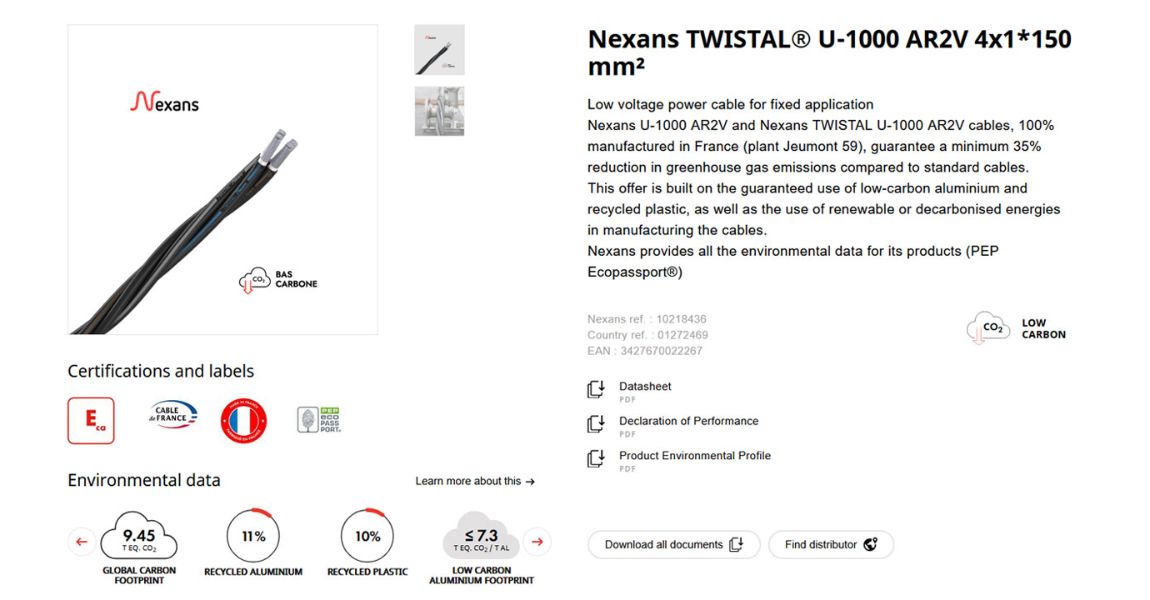
A robust set of indicators derived from LCA and PEP declarations can now be found on the product pages in the catalogue
- Global carbon footprint: amount of greenhouse Gas, including CO2, emitted Cradle to Gate and expressed in tons equivalent CO2 (t eq. CO2)
- Percentage of recycled metal in the cable conductor.
- Percentage of recycled plastic contained in the insulation or the sheath
- Low carbon aluminium footprint - if the conductor is made of 100% supply of so-called‘low-carbon’ aluminium manufacturing site
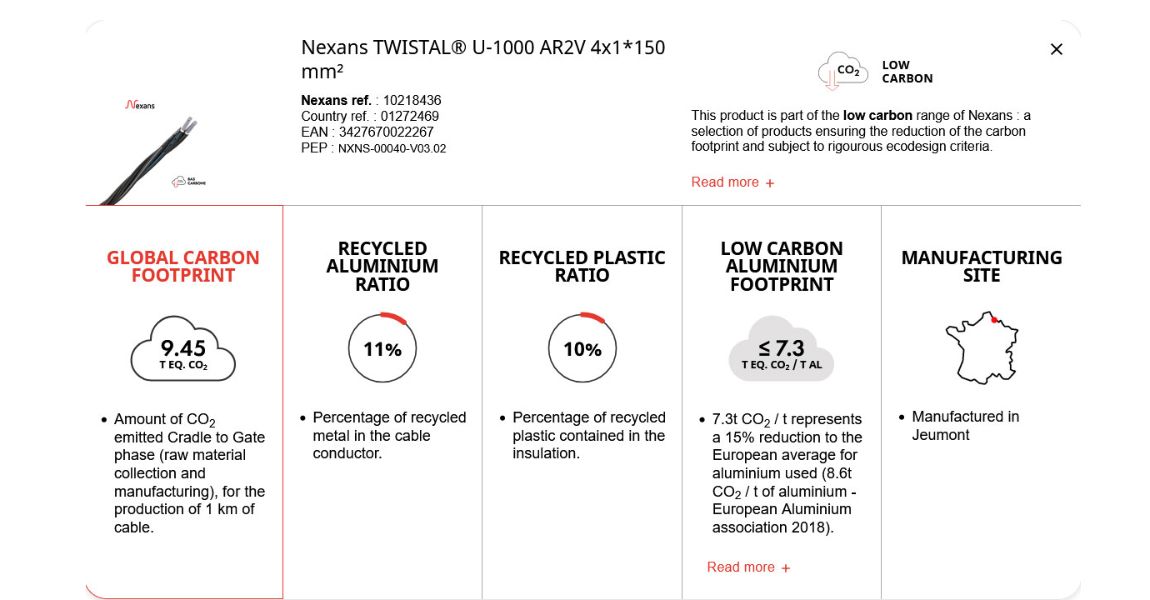
In addition to these criteria, a specific logo helps identify products belonging to Nexans low carbon offering. Nexans products bearing the Low Carbon sign contribute to a circular economy by activating levers that guarantee:
- Minimum inclusion of 10% recycled copper or aluminiumand/or 100% low-carbon aluminium sourcing.
This transparency not only fosters a better understanding of environmental impact but also encourages continuous improvement of processes and technical solutions.
By facilitating access to accurate environmental data, this initiative offers an inspiring model for responsible electrification on a global scale – a genuine lever to accelerate the low-carbon transition in the infrastructure and construction sectors.
Our websites
Select your country to find our products and solutions
-
Africa
- Africa
- Ghana
- Ivory Coast
- Morocco
- North West Africa
- Americas
- Asia
- Europe
- Oceania