- Markets
- Products
- Services
- News
- Tools & Resources
- About Nexans
- Search
- Contact us
- Compare
- Sign in


Easy to install
H07RN-F cable: uses, benefits and selection criteria
May 21, 2026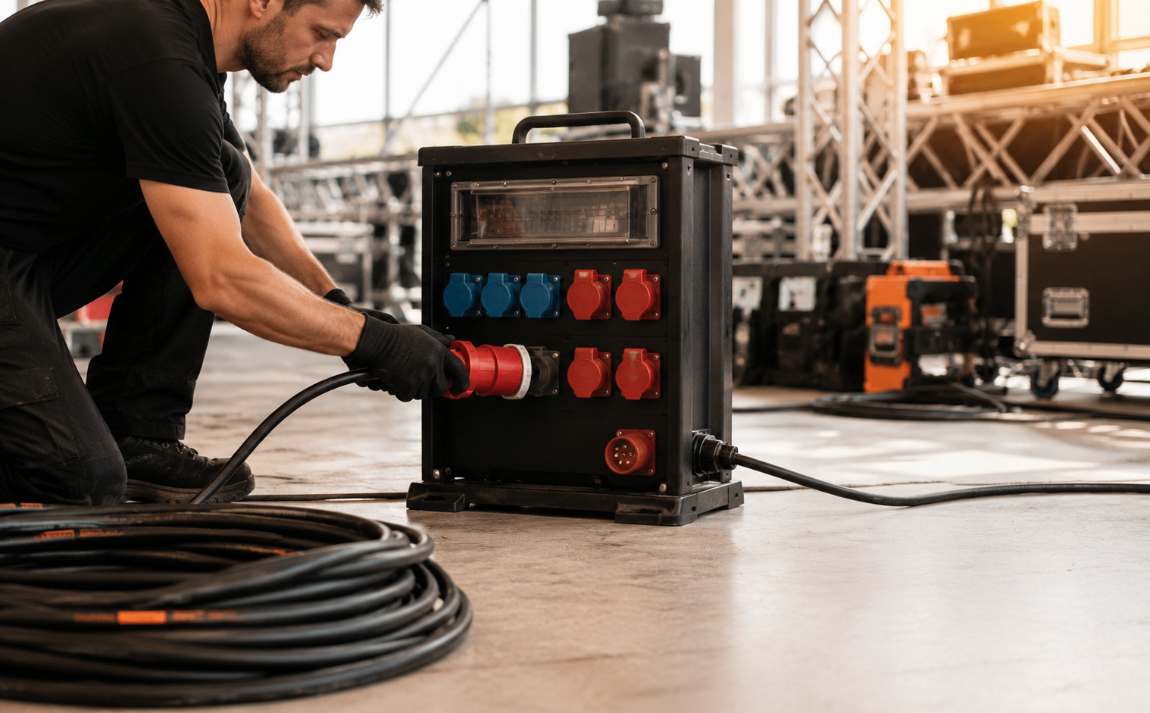
The H07RN-F cable is a reference solution for electrical installations exposed to mechanical, climatic or chemical constraints. Thanks to its flexibility, rubber sheath and resistance to demanding conditions, it is used in many professional environments: industry, construction sites, ports, temporary installations, outdoor events, generators and machine connections.
However, every application has its own specific constraints. Before choosing an H07RN-F cable, several criteria should be considered: type of installation, environment, temperature, conductor cross-section, rated voltage, mechanical resistance, marking and installation conditions.
This article presents the main uses of H07RN-F cable and the key points to check when selecting a solution adapted to your installations.
What is an H07RN-F cable?
An H07RN-F cable is a flexible cable designed for mobile or fixed installations. It generally combines EPR-type rubber insulation with an outer rubber sheath, enabling it to meet the requirements of more demanding environments than a standard cable.
The H07RN-F marking provides several indications:
- H: harmonised cable according to European standards;
- 07: rated voltage of 450/750 V;
- R: rubber insulation;
- N: polychloroprene or equivalent sheath material;
- F: flexible conductor.
This construction provides a cable suitable for installations requiring flexibility, mechanical resistance and performance in demanding environments.
What is an H07RN-F cable used for?
H07RN-F cable is used in a wide range of environments where the cable may be handled, exposed, moved or subjected to repeated constraints.
Industrial installations
In industrial environments, cables may be exposed to vibrations, movement, oils or certain chemicals. H07RN-F cable is therefore suitable for applications such as:
- machine power supply;
- motor connections;
- mobile equipment;
- workshops;
- environments exposed to mechanical constraints.
Construction sites and temporary installations
On construction sites, cables may be laid on the ground, moved, exposed to humidity, frequent traffic or changing outdoor conditions. H07RN-F cable is a relevant solution for:
- temporary power supply;
- temporary installations;
- mobile equipment;
- outdoor areas;
- connections exposed to frequent handling.
Events, festivals and concerts
In the event industry, electrical installations are often temporary and exposed to demanding real-life conditions: fast assembly, dismantling, storage, wet ground, mud, repeated traffic, and connection to distribution boards or generators.
H07RN-F cable is therefore suitable for environments such as:
- festivals;
- concerts;
- trade shows;
- sporting events;
- outdoor events;
- temporary stages;
- event electrical distribution.
In these situations, the cable is not just an accessory. It contributes to the reliability of the electrical installation and to event continuity.
Generators and temporary power
H07RN-F cable is also used for connections related to temporary power, especially when installations need to remain reliable outdoors or in mobile environments.
It can be used for:
- generators;
- temporary distribution cabinets;
- backup power installations;
- mobile equipment power supply;
- events requiring temporary power.
What are the main benefits of an H07RN-F cable?
1. High flexibility
Flexibility is one of the main benefits of H07RN-F cable. It makes handling, unwinding, connection and installation easier, especially in confined environments or temporary installations.
This flexibility is particularly useful when the cable needs to be moved, coiled, uncoiled or reused regularly.
2. Mechanical resistance for intensive use
H07RN-F cable is designed to withstand significant mechanical constraints: impacts, crushing, repeated handling, vibrations or occasional traffic.
This resistance makes it suitable for professional environments where the cable is frequently exposed to demanding operating conditions.
3. Suitable for indoor and outdoor use
Depending on installation conditions, H07RN-F cable can be used indoors or outdoors. It is particularly relevant in environments where the cable may be exposed to humidity, temperature variations or field constraints.
4. Good resistance to oils and chemicals
Some industrial environments, construction sites or temporary installations may involve accidental exposure to oils or chemicals. H07RN-F cable is designed to meet this type of requirement.
5. A solution for mobile and protected fixed installations
H07RN-F cable can be used in mobile installations with a rated voltage of 450/750 V. It can also be used in protected fixed installations up to 0.6/1 kV, according to the conditions specified in the technical datasheet.
What criteria should be checked before choosing an H07RN-F cable?
The type of installation
The first criterion to check is the type of installation: mobile, temporary, protected fixed, outdoor or indoor.
A cable intended to be handled regularly will not be exposed to the same constraints as a cable installed in a fixed position. The conditions of use should therefore be clearly identified before selecting the reference.
The operating environment
Cable selection should take the operating environment into account:
- indoor or outdoor use;
- presence of humidity;
- exposure to oils or chemicals;
- mechanical constraints;
- vibrations;
- repeated traffic;
- temporary or long-term installation.
The more demanding the environment, the more important it becomes to choose a robust and suitable cable.
The conductor cross-section
The conductor cross-section should be selected according to the current, cable length, acceptable voltage drop and installation conditions. An unsuitable cross-section may lead to performance losses or excessive heating.
For event installations or generator connections, cross-sections can vary significantly depending on the required power.
The operating temperature
The maximum conductor temperature can reach 90°C, with a maximum short-circuit temperature of 250°C. The ambient operating temperature depends on the references and installation conditions.
This point is essential for environments exposed to temperature variations or thermal constraints.
The rated voltage
The rated voltage is generally 450/750 V for mobile use and 0.6/1 kV for protected fixed installations.
This criterion should be checked according to the type of installation and intended application.
The bending radius
Respecting the minimum bending radius is essential to preserve cable performance.
For an H07RN-F cable, the recommended bending radius varies depending on the type of use:
- dynamic use: 6 to 8 times the outer cable diameter;
- static installation, outer diameter ≤ 12 mm: 3 times the outer diameter;
- static installation, outer diameter > 12 mm: 4 times the outer diameter.
The marking
Clear marking makes it easier to quickly identify the cable cross-section and characteristics. Metre marking also supports cable length management by allowing users to unwind only the required length.
On construction sites, in workshops or in event environments, this can save valuable time.
H07RN-F TITANEX®: a Nexans solution for demanding environments
The H07RN-F TITANEX® range from Nexans offers flexible cables with elastomer sheaths, designed to meet the requirements of indoor and outdoor installations, including demanding environments.
H07RN-F TITANEX® stands out thanks to:
- very high flexibility;
- very high crushing resistance;
- good resistance to oils, chemicals and vibrations;
- durable marking;
- metre marking;
- suitability for mobile or protected fixed installations;
- French manufacturing for the relevant references.
For more than 50 years, H07RN-F TITANEX® has supported professionals in a wide range of environments: factories, construction sites, ports, machines, generators, outdoor events, festivals and concerts.
Choosing the right H07RN-F cable
Find answers to key questions about selecting an H07RN-F cable, from installation type and cross-section to bending radius, marking and demanding environments.
Mobile use refers to installations where the cable may be handled, moved or reused. Protected fixed installation refers to a more permanent setup where the cable is installed with appropriate protection according to the application.
Respecting the minimum bending radius helps preserve the cable’s mechanical and electrical performance, especially when the cable is handled, routed or installed in constrained spaces.
H07RN-F TITANEX® combines flexibility, mechanical resistance and resistance to demanding environments, making it suitable for temporary installations exposed to handling, movement, outdoor conditions or repeated use.
Clear cable marking helps identify the cable characteristics more quickly and supports easier cable management during installation, maintenance or repeated use.
The main criteria to check are the type of installation, the operating environment, the conductor cross-section, the rated voltage, temperature constraints, bending radius and cable marking.
The conductor cross-section should be selected according to the current, cable length, acceptable voltage drop and installation conditions. For demanding applications, the technical datasheet should always be checked before selecting the reference.
Our websites
Select your country to find our products and solutions
-
Africa
- Africa
- Ghana
- Ivory Coast
- Morocco
- North West Africa
- Americas
- Asia
- Europe
- Oceania